Alation · Applied AI · Internal Tool in Beta
Arc: Agentic Sales Platform
Transforming the Quarterly Value Alignment process from a static sales book into a living, agentic platform — one that ingests customer context, generates strategic use cases, and produces quantified action plans that grow with every account.
Delivering Outcomes Efficiently
Evolving the QVA experience into a platform that replaces manual deal preparation with AI-driven strategic alignment, shifting sales teams from selling features to delivering quantified business outcomes.
“Instead of a book, why not build a platform that grows and adapts for each client — one that takes in real customer data and produces something dynamic?”
It Started as a Book
Alation's sales and enablement teams run a new process called the Quarterly Value Alignment (QVA): a structured meeting with customers to ensure they're receiving value from the platform and to identify expansion opportunities. The QVA is where Alation shifts from selling features to understanding how a customer's strategic initiatives are driving toward quantifiable outcomes.
The initiative was originally given to a product manager who was tasked with creating a sales playbook: a static reference book to help reps position Alation 2.0 features. When I was brought onto the team, I questioned the premise: a static book would be outdated the moment it was printed. Customer contexts change. Strategic initiatives shift. New product capabilities ship. A fixed document can't adapt to any of that.
From Pushback to CEO Buy-In
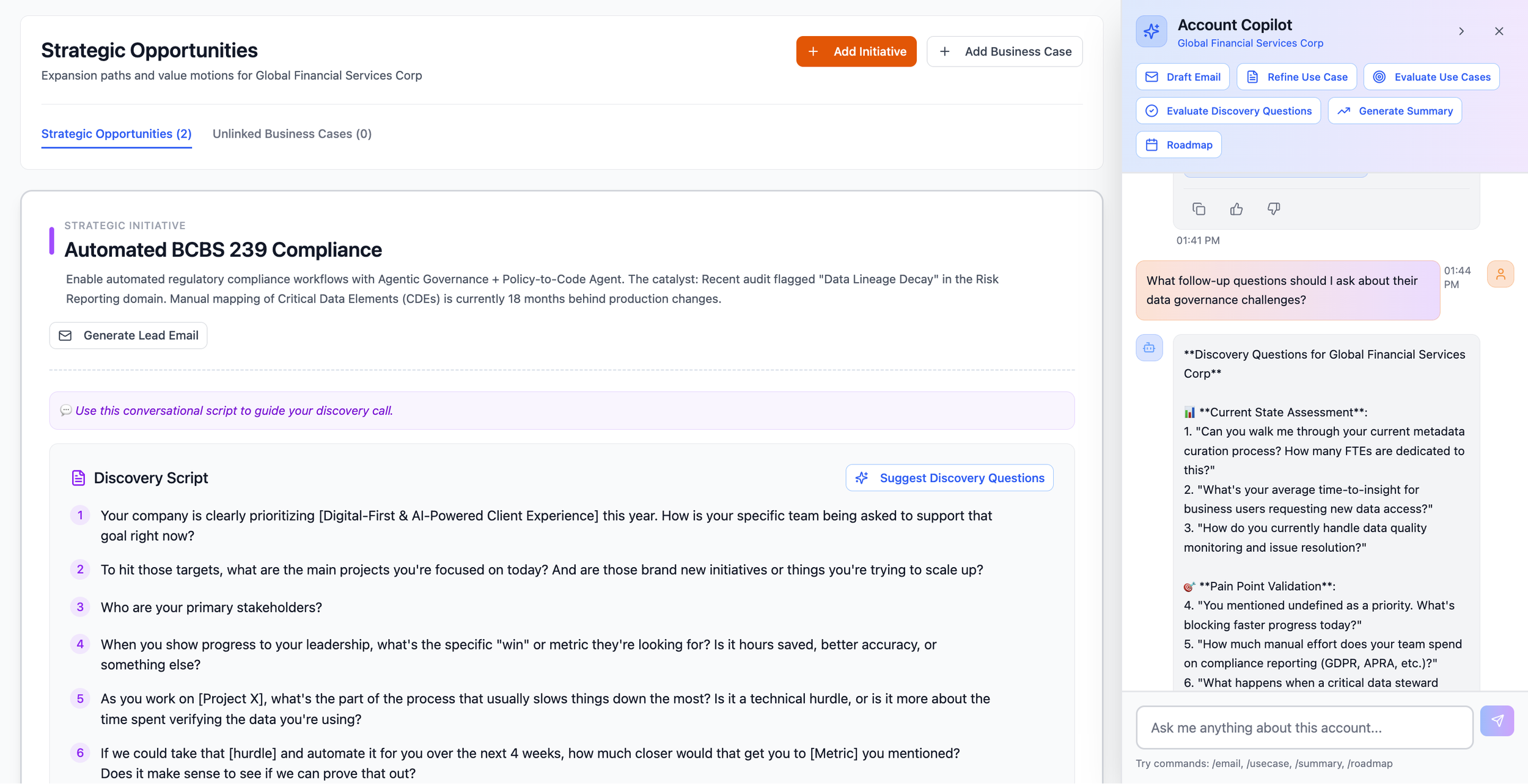
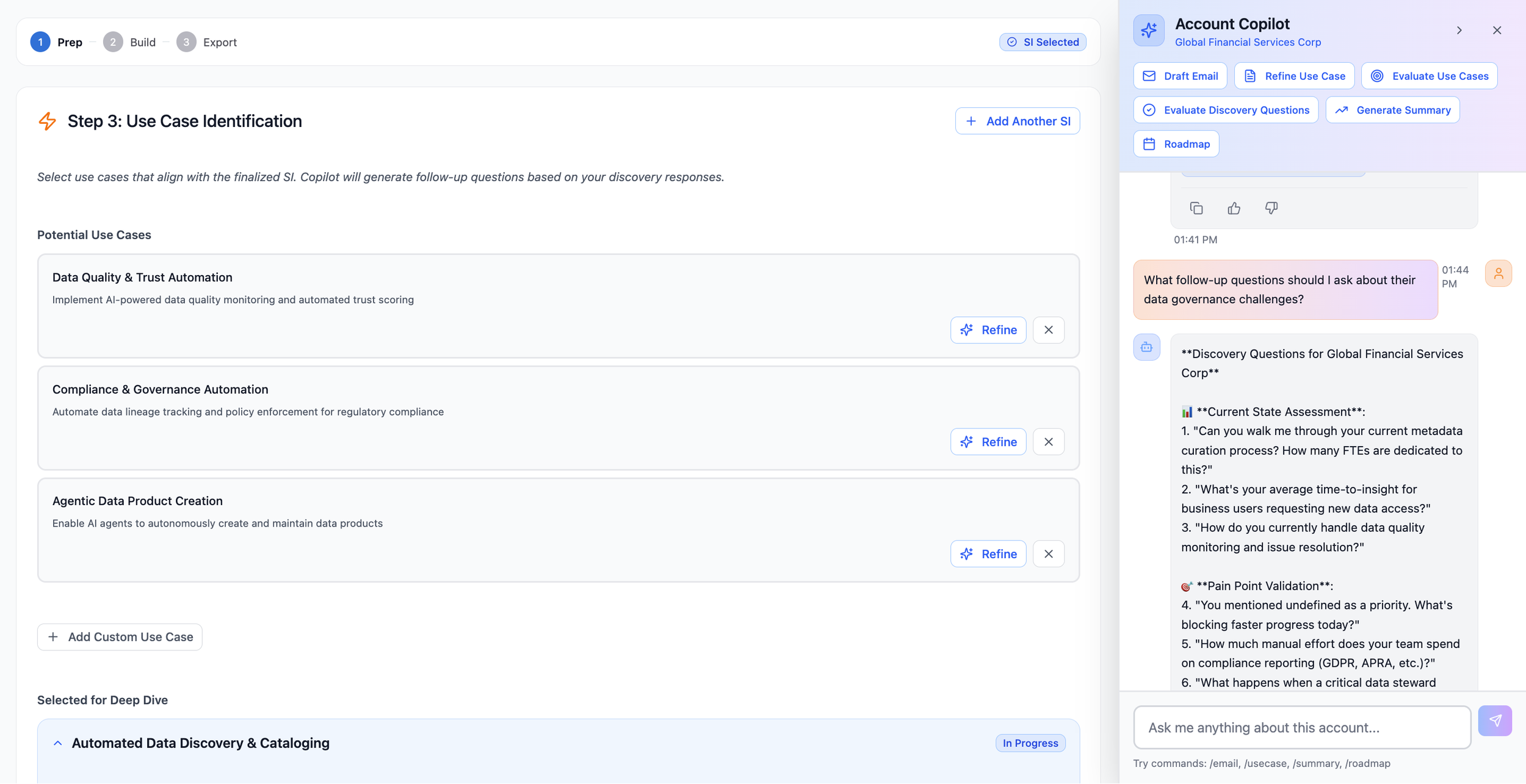
As lead product designer, I owned the end-to-end platform experience — the interaction design, the workflow architecture, and the user-facing behavior of every screen from first input to final export. The PM and engineering lead owned the agent logic and prompt engineering; my job was designing how that intelligence shows up for the user. I used Figma Make to rapidly explore several directions and iterate on the full end-to-end flow, testing ideas that would have taken weeks to spec traditionally.
The prototype I presented to Alation's CEO changed the initiative's direction entirely. He dropped the book concept and went fully on board with the agentic platform. What started as a request for a static sales reference became a living, adaptive tool because I challenged the brief and showed a better alternative rather than executing the original ask.
The product manager was instrumental in driving toward the end-to-end platform, keeping us focused while timelines were tight. Together, we shipped a functional beta in under a month. I was invited alongside the PM to Alation's Sales Kickoff to present the work and gather feedback directly from the teams it was built for.
When the prototype was handed to engineering, they found it straightforward to replicate the established designs and flows with minimal back-and-forth, a direct result of the fidelity and clarity of the prototype. Sales teams are already excited about the product, saying it will let them focus on delivering value and connecting with customers rather than manually creating decks.
The Agentic Workflow
Six stages, four input sources, one persistent copilot. Each step produces an artifact that builds on the last.
Patterns for AI Agent Interactions
Three principles guided Arc and established the interaction patterns for Alation's broader agent platform:
Human-in-the-loop at every stage.
The agent never auto-publishes. Every transition includes a review checkpoint. The rep stays in control of the narrative their name is on.
Conversation, not automation.
The flow is a conversation with opportunities for refinement throughout. The agent proposes, the rep responds, and each round of back-and-forth earns a little more trust. Over time, reps develop confidence in what the system does well and where they need to intervene. Trust is built through repeated, transparent interaction.
Design for day one, architect for day 100.
Success stories, the editable export, and the cross-account libraries were all designed to deliver immediate value while creating the infrastructure for the system to improve over time. One honest limitation: the quality of CRM data going in directly affects the quality of what comes out. There's a bit of work ahead to clean up Salesforce inputs so the platform can deliver on its full potential.
What Arc Proved
Arc is still in beta, but its impact has already been felt across the organization:
Challenging the brief was the right call.
The original ask was a static book. The prototype convinced the CEO to abandon that direction entirely and invest in a living platform instead. Questioning the premise and showing an alternative rather than just arguing against the original idea changed the direction of the initiative.
Speed creates organizational conviction.
A functional beta in under a month demonstrated a new velocity for the team. The Sales Kickoff invite was proof that the work was immediately useful to the people it was built for.
Prototype fidelity reduces engineering friction.
Engineering replicated the designs with minimal back-and-forth, a direct result of using Figma Make to build high-fidelity, well-thought-through flows before handoff. The prototype acted as a blueprint to build off of.
Sales teams are already shifting their mindset.
Early feedback from reps: they'll be able to focus on delivering value and connecting with customers instead of manually creating decks. The tool is changing how they think about deal preparation, from assembly work to strategic work.
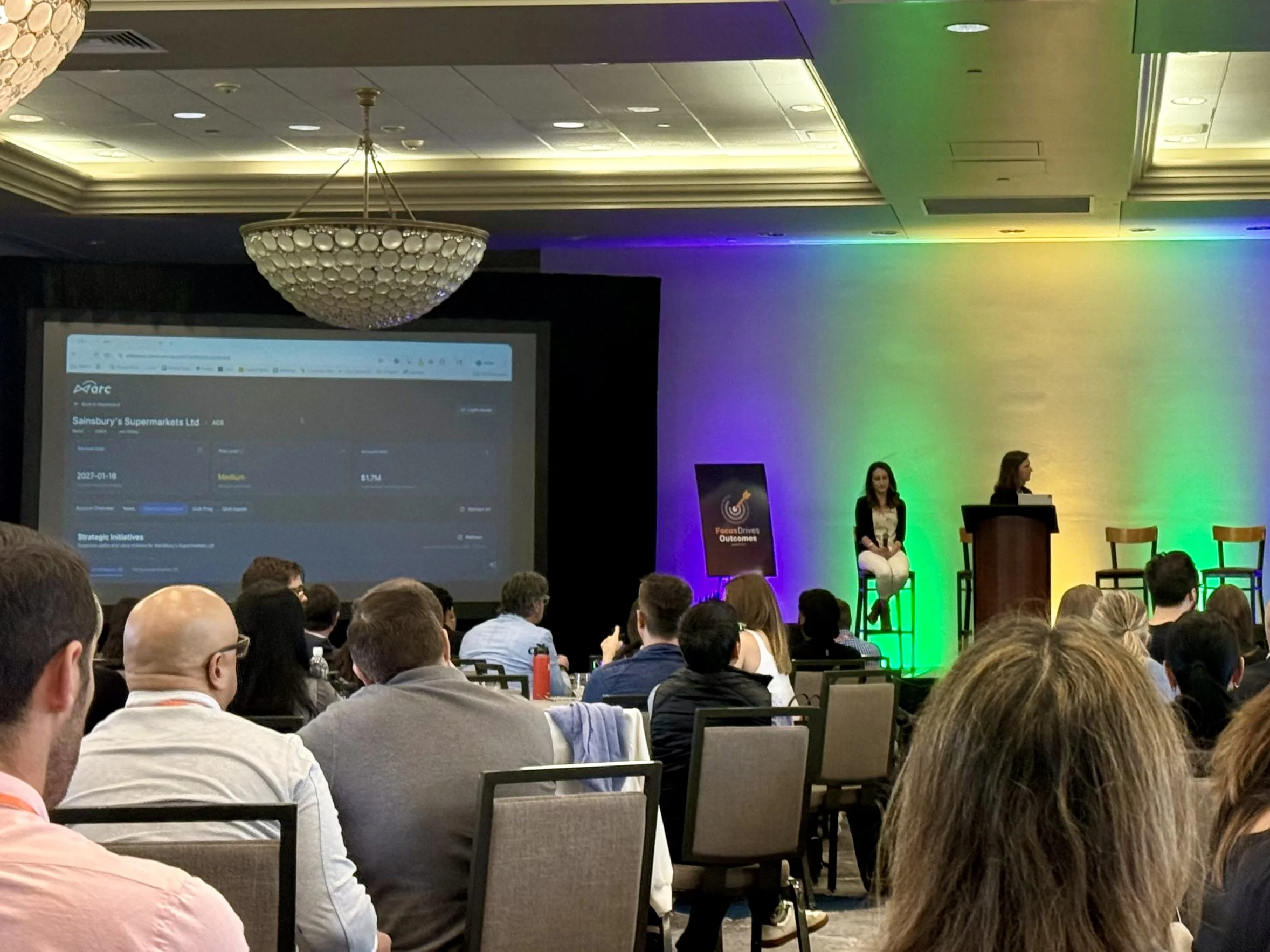
Product Manager and Sales Lead presenting Arc at the Sales Kick-off.